St Hilda's Anglican Catholic Church Service Times

You are invited to join us for Anglican Catholic Holy Communion / Mass on:
Every Sunday, Maitland NSW Australia. Venue: St Marys School Chapel in Victoria St. Mass at 11am.
Email
Fr Matthew Kirby for further details.
Check here for any additions or cancelations of services.

Monday, 23 February 2015

not conformed but transformed - by faith

Sermon Summary for Epiphany 1 - 2015 presented by Fr Matthew Kirby

I beseech you therefore, brethren, by the mercies of God, that ye present your bodies a living sacrifice, holy, acceptable unto God, which is your reasonable service. And be not conformed to this world: but be ye transformed by the renewing of your mind, that ye may prove what is that good, and acceptable, and perfect, will of God. For I say, through the grace given unto me, to every man that is among you, not to think of himself more highly than he ought to think; but to think soberly, according as God hath dealt to every man the measure of faith.  For as we have many members in one body, and all members have not the same office:  So we, being many, are one body in Christ, and every one members one of another. (Romans 12:1-5)

"be not conformed to this world"
 
World = the systems and culture of man, insofar as they are founded and formed in disobedience to God. Not everything in culture or institutions is included in this, it is not referring to that which is morally neutral or virtuous for E.g., styles of cooking (if they do not directly cause gluttony) or clothing (if they do not encourage impurity) these may usually be conformed to, and laws forbidding murder must be.
 
But we must not follow the pack when it comes to customs and practices that are sinful. It is primarily the responsibility of the individual adult Christian to identify and avoid immoral actions even if they are common and to self-censor when it comes to reading, listening and watching, according to their (divinely assisted) conscience. (No Index of Prohibited Books for Anglican, or even for Roman Catholic now!) But sometimes the Scripture or the Church will explicitly forbid certain culturally accepted practices. E.g., abortion in our society, polygamy in some others.
 
"but be transformed by the renewing of your mind"
 
As I have said before, we do this primarily by reading and meditating on Scripture (or other edifying literature) and by prayer, but also by the practice of obedience. So there is both the negative (avoiding worldiness) and the positive (fostering godliness). Both are necessary. The positive attempted with the negative allows too much muddying of the mental waters. The negative without the positive makes for ineffectual, miserable Christians who only know "don'ts". Also, the ability of our conscience to filter out the bad is enhanced by the positive.
 
"according to the measure of faith"
 
If we want to not only transform ourselves but build up others, we must use our gifts of the Spirit to minister in the Church. But we do this to the extent we trust in the Giver of the gift and the gift itself that he gives. To play our part in the Church, to activate our gift, requires faith. It requires the confidence or courage to act, trusting that God will then act through us and around us, and asking for that very thing.  

Monday, 16 February 2015

Invitation to Ash Wednesday Service


Ash Wednesday Service
St Hilda's Anglican Catholic Parish
Wednesday 18th February 2015, at noon.
Venue - St Marys School Chapel in 
Victoria St Maitland NSW
All Welcome.

Thursday, 12 February 2015

Dealing with a miracle of God

Christmas II Sermon Summary 2015 presented by Fr Matthew Kirby
 
And she brought forth her firstborn son, and wrapped him in swaddling clothes, and laid him in a manger; because there was no room for them in the inn. And there were in the same country shepherds abiding in the field, keeping watch over their flock by night. And, lo, the angel of the Lord came upon them, and the glory of the Lord shone round about them: and they were sore afraid.  And the angel said unto them, Fear not: for, behold, I bring you good tidings of great joy, which shall be to all people. For unto you is born this day in the city of David a Saviour, which is Christ the Lord. And this shall be a sign unto you; Ye shall find the babe wrapped in swaddling clothes, lying in a manger. And suddenly there was with the angel a multitude of the heavenly host praising God, and saying, Glory to God in the highest, and on earth peace, good will toward men. And it came to pass, as the angels were gone away from them into heaven, the shepherds said one to another, Let us now go even unto Bethlehem, and see this thing which is come to pass, which the Lord hath made known unto us. And they came with haste, and found Mary, and Joseph, and the babe lying in a manger. And when they had seen it, they made known abroad the saying which was told them concerning this child. And all they that heard it wondered at those things which were told them by the shepherds. But Mary kept all these things, and pondered them in her heart. And the shepherds returned, glorifying and praising God for all the things that they had heard and seen, as it was told unto them. (Luke 2:7-20)
"the shepherds returned, glorifying and praising God"
 
They returned. Went back to their lives, their work, their shepherding. Did not become apostles, rabbis or prophets.
 
But they were not shy about telling others of the wonderful things they had experienced of God, as we are told in today's Gospel. And they carried the joy of those wonders (angelic visitation followed by the sight of the new born Christ-child) with them in grateful memory, back into their normality.
 
They did not abandon their flocks or try to hang around the Holy Family, clinging to the experience, trying to prolong it or repeat it.
 
Nor did they forget it or dismiss it. Luke knew and wrote of what happened to them and what they afterwards did, and he did so decades later. He may well have heard it from them or those to whom they spoke. The joy remained, the impact was permanent.
 
There is a lesson for us here. Even Christians who experience amazing things in God, spend most of their lives experiencing normality, not miracles. We are not meant to try to prolong artificially those times of the extraordinary in our spiritual walk. Nor are we to seek repetition, or a perpetual series of new excitements. This would be ungrateful and immature.
 
Instead, we must use our memory of the high points to inspire us to praise in the present and joyful witness to God's goodness. That is how we can make the wonderful times food for the journey and perpetual in benefit. God normally works normally. But he also performs signs and specially touches our lives at times. Never forget these, and use them to strengthen yourself in the midst of the hard slog, whether they be your own experiences, or those testified to you by others.
Finally, let others know what God has done for you.

Be My Valentine...

Saints are recognised as having fulfilled the highest aspirations of religious teaching, surrendering to God's love so generously that the Church recognises them as heroes and heroines worthy to be held up for our inspiration.  They are role models of holiness to be imitated, strengthening and encouraging the believer within us, during the times of weakness in our spiritual journey. They remind us of the level of dedication and success achievable through the mercy and grace of God.
 
If we are to use Saints as role models to imitate then it is necessary  to look at why a particular person became recognised by the Church.
So, what is Valentines Day other than chocolate, roses and a romantic suggestion? 
What does that have to do with my relationship with God?
 
The feast of St. Valentine (of February 14) dates back to 496 when Pope Gelasius 1 included Valentine among all those "... whose names are justly reverenced among men, but whose acts are known only to God." So we are a bit lacking in the factual recordings of this particular Saint. However a lot of the early Saints do have legends that develop.
 
There are many legends behind Saint Valentine. Story has it that while under house arrest, because he defied the order of the emperor Claudius and secretly married couples so that the husbands wouldn't have to go to war. Soldiers were sparse at this time so this was a big inconvenience to the emperor. To remind Soldiers and persecuted Christians of their vows and God’s love, Saint Valentine is said to have given them hearts cut from parchment. Saint Valentine (who was a former Bishop) was challenged during a discussion about faith by Judge Asterius while under arrest. The judge insisted that Valentine prove his faith and the validity of Christ by restoring the eye sight of the Judges adopted blind daughter. If successful Asterius would do anything Valentine asked. Valentine laid his hands on her eyes and the child's vision was restored. Immediately humbled, the judge asked Valentine what he should do. Valentine replied that all of the idols around the judge's house should be broken, the judge should fast for three days, and then undergo baptism. The judge obeyed and as a result, freed all the Christian inmates under his authority. The judge, his family and his forty-four member household (family members and servants) were baptized. Valentine was later arrested again and had to face the emperor Claudius. Valentine tried to convert Claudius to Christianity, but Claudius refused and condemned him to death, commanding that Valentine either renounce his faith or he would be beaten with clubs, and beheaded. Valentine refused and Claudius' command was executed February 14, 269. Legend has it that on the day of his execution he left the girl a note that was signed “Your Valentine" as a farewell.
 
It is interesting that the celebration of Saint Valentine did not have any romantic connotations until 1381 when Chaucer wrote:
For this was on seynt Volantynys day
Whan euery bryd comyth there to chese his make.

Translated: 

For this was on St. Valentine's Day,
when every bird cometh there to choose his mate.
 
The verse Roses are red is traceable as far back as 1590:
She bath'd with roses red, and violets blew,
And all the sweetest flowers, that in the forrest grew.


And this version dates 1784:
The rose is red, the violet's blue,
The honey's sweet, and so are you.
Thou art my love and I am thine;
I drew thee to my Valentine:
The lot was cast and then I drew,
And Fortune said it shou'd be you.


So this Valentines Day when you are feeling all romantic and loving, step back from the commercial card rack and give a thought to the purpose of recognising Saints. Valentines Day wasn't invented to romance the opposite sex. Its purpose was to honour a Saint and to learn by his example. In the legends that developed about Saint Valentine he wasn't trying to win the heart of a young maiden, but rather he puts his dedication to his faith and love of God, followed by his love for and serving of others, above everything including his own safety.

O'Saint Valentine,

 the lover of Christ and of the church,
we ask for your intercession
so that we may learn to love God above all things,
and to selfishly love one another.
O'Glorious Saint Valentine pray for us,
that we too may have the steadfast faith of the martyrs.

Almighty God, strengthen my faith.
Give me the courage to always place you first.
Fill my soul with the love of God
so that it may shine forth into the world.
Fill my heart with your love for man
so that I may serve them well according to your will.
Amen

Lord Jesus Christ... be my Valentine.

Saturday, 7 February 2015

To Judge, Or Not To Judge

Sermon Summary for Advent III 2014 presented by Fr Matthew Kirby

"judge nothing before the time"  (1 Corinthians 4:5) But compare this with "For I verily, as absent in body, but present in spirit, have judged already, as though I were present, concerning him that hath so done this deed ... do not ye judge them that are within?" "Know ye not that we shall judge angels? how much more things that pertain to this life?" [1 Corinthians 5:3,12b and 6:3]. From the same letter! And, of course, (Matthew 7:1), "Judge not, that ye be not judged."

Can't God make up his mind? Or St Paul?
The very fact these apparently contradictory verses are so close to each other warns us to pay careful attention. St Paul knows exactly what he is saying, and is doing this deliberately.

Where we are told by the Apostle to "judge nothing", the context is presuming to Judge as God does, knowing the very heart, knowing everything, and thus being able to condemn or justify the person themselves definitively: "Therefore judge nothing before the time, until the Lord come, who both will bring to light the hidden things of darkness, and will make manifest the counsels of the hearts: and then shall every man have praise of God." Jesus actually warns us not to judge others with a different standard to ourselves: "For with what judgment ye judge, ye shall be judged: and with what measure ye mete, it shall be measured to you again. And why beholdest thou the mote that is in thy brother's eye, but considerest not the beam that is in thine own eye? Or how wilt thou say to thy brother, Let me pull out the mote out of thine eye; and, behold, a beam is in thine own eye? Thou hypocrite, first cast out the beam out of thine own eye; and then shalt thou see clearly to cast out the mote out of thy brother's eye." [Matthew 7:2-5]. This is so easy for us to do thoughtlessly.

Where we are told we should judge, we must begin with ourselves, as our Lord just reminded us about the plank. St Paul says, in reference to preparing for Communion, "But let a man examine himself, and so let him eat of that bread, and drink of that cup. For he that eateth and drinketh unworthily, eateth and drinketh damnation to himself, not discerning the Lord's body." [1 Corinthians 11:28-29].
Then we must approach the situations of others with honesty and courage. We cannot judge as God does, but we can judge to be truly sinful the manifest, outward sins of others. And, if we have the authority, we may even have to pronounce sentence, for example, excluding the obstinate sinner from the Church. St Paul harshly criticises the Corinthians for failing in these duties. Why? Because if we do not honestly pronounce as evil what certainly is so, we actually harm the sinner by suppressing the truth. They are unlikely to repent if unchallenged, if their wickedness is ignored. He tells the Corinthians to "To deliver such an one unto Satan for the destruction of the flesh, that the spirit may be saved in the day of the Lord Jesus." [1 Corinthians 5:5.]


However, whenever we merely correct others for what we have discerned as sins, we must do so gently and humbly, remembering our own weakness and acting for the good of their soul. "And of some have compassion, making a difference: And others save with fear, pulling them out of the fire; hating even the garment spotted by the flesh." [Jude 22, 23]

So, what is the overall balance?
* We are to judge ourselves first, other second, with consistency.
* We are permitted to judge mentally, and to speak forth that judgement when and how it can be done charitably.
* We are generally to judge sins, not to condemn sinners.
* If in the appropriate position of authority (whether in the family, church or world), we are to judge honestly and apply consequences fairly.
* And we are always to remember the limited and fallible nature of our judgements in everything we do and say. 

Thursday, 1 January 2015

Happy New Year!

 
Hope everyone had a lovely Christmas day.
Happy New Year!
 
During 2015
May Gods blessings on you and your loved ones be abundant,
And may your faith, love and hope in Jesus strengthen,
to reflect the light of God on all those around you.
Amen.


Monday, 24 November 2014

The day I died.

 
"Be strong and of a good courage, fear not, nor be afraid of them: for the Lord thy God, he it is that doth go with thee; he will not fail thee, nor forsake thee" Deuteronomy 31:6  (KJV)
 
"And the Lord, he it is that doth go before thee; he will be with thee, he will not fail thee, neither forsake thee: fear not, neither be dismayed." Deuteronomy 31:8 (KJV)
 
"If ye then be risen with Christ, seek those things which are above, where Christ sitteth on the right hand of God. Set your affection on things above, not on things on the earth. For ye are dead, and your life is hid with Christ in God." Colossians 3:1-3(KJV)

Forsake me not Lord, for without you I am but an emtpy shell.
Embrace me in my time of need, letting the peace of God settle in my heart.
Let the word of Christ dwell in me, teaching me wisdom.
For whatsoever I now do, I do in the name of the Lord Jesus,
so that I can sing with grace in my heart to praise my God.

Amen.

Saturday, 15 November 2014

Shod with the preparation

Sermon Summary for Trinity XXI 2014 presented by Fr Matthew
 
My brethren, be strong in the Lord, and in the power of his might. Put on the whole armour of God, that ye may be able to stand against the wiles of the devil. For we wrestle not against flesh and blood, but against principalities, against powers, against the rulers of the darkness of this world, against spiritual wickedness in high places. Wherefore take unto you the whole armour of God, that ye may be able to withstand in the evil day, and having done all, to stand. Stand therefore, having your loins girt about with truth, and having on the breastplate of righteousness; And your feet shod with the preparation of the gospel of peace; Above all, taking the shield of faith, wherewith ye shall be able to quench all the fiery darts of the wicked. And take the helmet of salvation, and the sword of the Spirit, which is the word of God: Praying always with all prayer and supplication in the Spirit, and watching thereunto with all perseverance and supplication for all saints; And for me, that utterance may be given unto me, that I may open my mouth boldly, to make known the mystery of the gospel, For which I am an ambassador in bonds: that therein I may speak boldly, as I ought to speak.
 
"your feet shod with the preparation of the gospel of peace" +
What does St Paul mean by this? How is a soldier's shoe a "preparation"? What have the feet got to do with the Gospel, the good news?

He is referring to Isaiah 52:7. "How beautiful upon the mountains are the feet of him that bringeth good tidings, that publisheth peace; that bringeth good tidings of good, that publisheth salvation; that saith unto Zion, Thy God reigneth!" Therefore, the feet are the feet of a messenger in the prophecy. In the original context, the messenger is to God's people, and his message is the good news that God is returning [52:8] "Thy watchmen shall lift up the voice; with the voice together shall they sing: for they shall see eye to eye, when the Lord shall bring again Zion." his exiled and scattered people to their homeland, out of the oppression of the Babylonians [52:4-5]. "For thus saith the Lord God, My people went down aforetime into Egypt to sojourn there; and the Assyrian oppressed them without cause. Now therefore, what have I here, saith the Lord, that my people is taken away for nought? they that rule over them make them to howl, saith the Lord; and my name continually every day is blasphemed." But the same chapter [vv.13-15]  foreshadows the overflowing nature of the prophecy, pointing to a servant "exalted ... very high", yet "marred more than any man" who shall "sprinkle [with his blood] many nations". In other words, this prophecy is directed finally at the Church gathered out of all lands and peoples, and at the crucified Christ.

So, we are to gladly proclaim our faith in Christ both to our fellow believers, for their encouragement, and to those yet to become so, to draw them in. Does this mean that we cannot be spiritual warriors unless we are evangelists, preachers? No, St Paul calls specific people evangelists, and notes that this is a gift for "some" [Ephesians 4:11], "And he gave some, apostles; and some, prophets; and some, evangelists; and some, pastors and teachers;" not all, like every gift of the Spirit [1 Corinthians 12]. "For to one is given by the Spirit the word of wisdom; to another the word of knowledge by the same Spirit; To another faith by the same Spirit; to another the gifts of healing by the same Spirit; To another the working of miracles; to another prophecy; to another discerning of spirits; to another divers kinds of tongues; to another the interpretation of tongues: But all these worketh that one and the selfsame Spirit, dividing to every man severally as he will. For as the body is one, and hath many members, and all the members of that one body, being many, are one body: so also is Christ.

But we must all be prepared to witness to our faith when the opportunity arises. That is why St Paul speaks of the "preparation" of the gospel of peace. The Greek word here is hetoimasia, meaning preparedness, readiness. It is based on the same root word as St Peter uses in his first letter, here: "Always be ready (hetoimoi) to give a defence to everyone who asks you a reason for the hope that is in you, with gentleness and reverence" [1 Peter 3:15] "But sanctify the Lord God in your hearts: and be ready always to give an answer to every man that asketh you a reason of the hope that is in you with meekness and fear:". That translates to three obligations in this area.

One, outsiders should know that we are people of hope, because of what we do and say. Hence, our faith should not be a secret, even if we are not preachers, and our behaviour and attitude should speak hopefulness. They should sense something of another, better world.

Two, we should reflect upon our personal faith intelligently, and defend it with reasons. Christianity is not, contrary to common misconceptions, about believing things for no reason. Both our Lord and the Apostles and Evangelists often appeal to evidence, such as miracles and Creation itself [e.g., John 14:11, "Believe me that I am in the Father, and the Father in me: or else believe me for the very works' sake." Acts 1:3, "To whom also he shewed himself alive after his passion by many infallible proofs, being seen of them forty days, and speaking of the things pertaining to the kingdom of God:" Romans 1:19-20 "Because that which may be known of God is manifest in them; for God hath shewed it unto them.For the invisible things of him from the creation of the world are clearly seen, being understood by the things that are made, even his eternal power and Godhead; so that they are without excuse:" ]. Interestingly, the Greek word St Peter uses that we translate defence is the same word that is the basis for the term "apologetics", the branch of Christian thought that is devoted to explaining the rational basis for our beliefs. Think about what led you to or strengthened you in our faith, and form your own "testimony". Read Christian apologetics and learn to utilise it. Know where to point people for answers when you're own limitations are reached, but pray that God will transcend those limitations as he works through you anyway.

Three, our defence should be with gentleness and reverence, which means it is a defence of truth without being a personal attack. We must strike the balance between being forthright and being sensitive, as both are necessary.

Let us then, as the Scouts say, "be prepared". We can't all be evangelists like Billy Graham or Bp Patterson (an Anglican missionary martyr) or St Francis of Assisi.
But we can all manifest and defend the Faith, and support one another in it.

Thursday, 13 November 2014

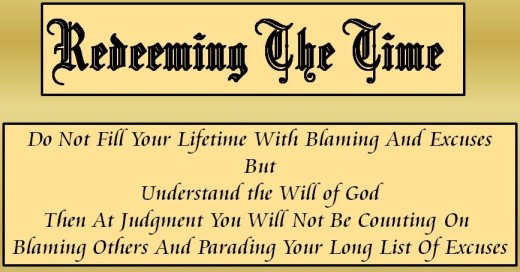
Redeeming Time, Heartfelt Melody & A Sinners Hospital.

Trinity XX 2014, Sermon Summary from Fr Matthew.

See then that ye walk circumspectly, not as fools, but as wise, Redeeming the time, because the days are evil. Wherefore be ye not unwise, but understanding what the will of the Lord is. And be not drunk with wine, wherein is excess; but be filled with the Spirit; Speaking to yourselves in psalms and hymns and spiritual songs, singing and making melody in your heart to the Lord; Giving thanks always for all things unto God and the Father in the name of our Lord Jesus Christ; Submitting yourselves one to another in the fear of God. Ephesians 5:15-21(KJV)
 
The kingdom of heaven is like unto a certain king, which made a marriage for his son, And sent forth his servants to call them that were bidden to the wedding: and they would not come. Again, he sent forth other servants, saying, Tell them which are bidden, Behold, I have prepared my dinner: my oxen and my fatlings are killed, and all things are ready: come unto the marriage. But they made light of it, and went their ways, one to his farm, another to his merchandise: And the remnant took his servants, and entreated them spitefully, and slew them. But when the king heard thereof, he was wroth: and he sent forth his armies, and destroyed those murderers, and burned up their city. Then saith he to his servants, The wedding is ready, but they which were bidden were not worthy. Go ye therefore into the highways, and as many as ye shall find, bid to the marriage. So those servants went out into the highways, and gathered together all as many as they found, both bad and good: and the wedding was furnished with guests. And when the king came in to see the guests, he saw there a man which had not on a wedding garment: And he saith unto him, Friend, how camest thou in hither not having a wedding garment? And he was speechless. Then said the king to the servants, Bind him hand and foot, and take him away, and cast him into outer darkness, there shall be weeping and gnashing of teeth. For many are called, but few are chosen. Matthew 22:2-14
 
"See then that ye walk circumspectly" +
 
There are 3 practical lessons for Christian living in today's Epistle and Gospel that I would like to draw out.
 
1. Redeeming the time:
To redeem time, as St Paul makes clear, demands wisdom and will. We must really think about what we do with our time. That does not mean there is no time for rest and recreation, but it does mean that we must ensure time is given to good works, and no time is wasted on foolishness or sin.


And it also means that we should plan ahead as best we can, and consciously allocate time, at least in a general way. How many of us say "I meant to do that, but never got around to it"? Well, in the same way that jobs often don't get done in communities unless a particular person is responsible for each particular task -- everybody's responsibility is nobody's responsibility -- our own tasks can remain like the end of the rainbow, never reached, unless we choose a specific time. Being organised, insofar as one can, is part of living a disciplined Christian life.

Of course, it would be just as silly in the other direction to make an idol out of a schedule, and refuse to be flexible in the face of life's surprises and others' unexpected needs. We do our best to redeem the time, but God is still the Lord of time.
 

2. Making melody in your heart to the Lord:
St Augustine it was, I think, who said that to sing hymns is to pray twice. Music makes it easier to remember the words, and brings a greater intensity to them. Find the Christian music you like the most, and listen to it. Then, as far as you can, sing it, even if only internally.

Note the St Paul says it needs to be in the heart. It may or may not also be on your lips, depending on circumstances and your confidence in your voice. But the beauty of the words of Christian hymns and songs can be utilised even without the music. So, use Hymn Books in your prayers! In addition to the Book of Common Praise, I have found the Book of Common Praise, for example, a wonderful and inspiring resource for prayer. It can also be a tool for meditiation. E.g., Litanies 677-682, Eucharistic devotions (and catechism!) 234, 241, biblical paraphrases such as 547. Get a good hymnal, and use it, with or without music.
 
3. Both bad and good:
People often complain about hypocrites in the Church, and there's no doubt they exist. They will then see this as a reason to dismiss the Faith. Even some Christians will use unworthy Church members as an excuse to push for a "purer" church, to limit membership as much as possible and declare that the unworthy are not really part of the church at all. They may even claim that a Church that acknowledges such "bad apples" as part of the fruit basket proves itself no church at all. But Jesus tells us in today's parable that even those who make it into the banquet, can end up being rejected, though it may take till the king arrives in judgement. Similarly, even lifelong communicant members of the Church can be outside the kingdom in their hearts and behaviour. There is no point using such people, or apparent examples of them, as an excuse to reject the Church. Jesus gave us fair warning. And, the fact is that the Church is obliged to give its flawed members the benefit of the doubt, and only overtly exclude those who manifestly and seriously act against its teaching in word or deed. Even then it is to reach out in the hope of reconciliation.

The Church is bigger than any merely human individual, good or bad. The Church, in its transcendental and fundamental identity, is the Body of Christ. But it's also a hospital for sinners, some of whom don't co-operate with their doctors or take their advice. Just like a normal hospital!

Accept the full reality. +

Sunday, 2 November 2014

Prayers for All Souls Day

By Thy resurrection from the dead, O Christ, death no longer hath dominion over those who die in holiness. So, we beseech Thee, give rest to Thy servants in Thy sanctuary and in Abraham's bosom. Grant it to those, who from Adam until now have adored Thee with purity, to our fathers and brothers, to our kinsmen and friends, to all men who have lived by faith and passed on their road to Thee, by a thousand ways, and in all conditions, and make them worthy of the heavenly kingdom.
(prayer drawn from the Byzantine Divine Liturgy)
 
O Lord, who art ever merciful and bounteous with Thy gifts, look down upon the suffering souls in purgatory. Remember not their offenses and negligence's, but be mindful of Thy loving mercy, which is from all eternity. Cleanse them of their sins and fulfil their ardent desires that they may be made worthy to behold Thee face to face in Thy glory. May they soon be united with Thee and hear those blessed words which will call them to their heavenly home: "Come, blessed of My Father, take possession of the kingdom prepared for you from the foundation of the world."
 
Eternal rest grant unto them, O Lord, and let perpetual light shine upon them. May the souls of the faithful departed, through the mercy of God, rest in peace, and rise in glory. Amen.
 
Join St Hilda's Parish
for Anglican Catholic Mass / Communion / Prayer / Worship for All Souls,
Monday evening 3rd Nov 2014 at 6pm.
St Marys Campus Chapel of the All Saints College,
Victoria Street Maitland NSW.

Prayers for All Saints Day

Almighty God,
who hast knit together thine elect in one communion and fellowship in the mystical body of Your Son, Christ our Lord: Give us grace so to follow Your blessed saints in all virtuous and godly living, that we may come to those ineffable joys that thou hast prepared for those who unfeignedly love thee; through the same Jesus Christ our Lord, who with thee and the Holy Spirit liveth and reigneth, one God, in glory everlasting. Amen
Book of Common Prayer, 1979
 
God,  source of all holiness, you have given us all the saints, our brothers and sisters, as models of Christian life. Known and unknown, named and unnamed, they are gathered now around Your table in heaven, where they enjoy the company of Your Mother Mary; your angels and one another. As pilgrims on the journey of faith on Earth, they showed their love, friendship, and care for us' still assisting us on our journey may their prayers lead us at last to the joy of the Eternal Jerusalem. We ask this through Christ the Lord.
(Carlo Saraceni 1590-1620)

Friday, 31 October 2014

This Weekend at St Hilda's

 
What's happening At St Hilda's Parish in Maitland?
 
All Saints Mass will be at 10:30am on Saturday 1st November.
Our usual Mass will be at 11:00am Sunday 2nd November.
All Souls Mass will be held at 6:00pm Monday 3rd November.

Wednesday, 22 October 2014

An Invitation To Dine with Jesus

Sermon Summary for Trinity XVII 2014
(Gospel from Luke 14) as presented by Father Matthew Kirby

And it came to pass, as he went into the house of one of the chief Pharisees to eat bread on the sabbath day, that they watched him. And, behold, there was a certain man before him which had the dropsy. And Jesus answering spake unto the lawyers and Pharisees, saying, Is it lawful to heal on the sabbath day? And they held their peace. And he took him, and healed him, and let him go; And answered them, saying, Which of you shall have an ass or an ox fallen into a pit, and will not straightway pull him out on the sabbath day? And they could not answer him again to these things. And he put forth a parable to those which were bidden, when he marked how they chose out the chief rooms; saying unto them. When thou art bidden of any man to a wedding, sit not down in the chief seat; lest a more honourable man than thou be bidden of him; And he that bade thee and him come and say to thee, Give this man place; and thou begin with shame to take the lowest seat. But when thou art bidden, go and sit down in the lowest seat; that when he that bade thee cometh, he may say unto thee, Friend, go up higher: then shalt thou have worship in the presence of them that sit at meat with thee. For whosoever exalteth himself shall be abased; and he that humbleth himself shall be exalted.

"Sit not down in the chief seat" 

This is not new teaching, even in it's wording.
Compare it to: "Put not forth thyself in the presence of the king, and stand not in the place of great men: For better it is that it be said unto thee, Come up hither; than that thou shouldest be put lower in the presence of the prince whom thine eyes have seen." Proverbs 25:6-7.

Yet Jesus does not refer
to the passage in the Old Testament here, unlike He has in other situations. It seems strange, especially when the point seems, at first glance, to be that you should pretend to be less, expecting to be treated as more. Is Jesus suggesting we practice false humility? What are we missing by interpreting it this way?

It's a wedding feast in the parable!
Unlike the feast he was at, unlike the context of Proverbs. Symbol of God's Kingdom in other parables. Christ is the true host. The chief seats may stand for those in authority (compare 24 elders in Revelation) or those of greater sanctity (the humble exalted are the virtuous exalted).
 
Thus, for the church, this means that men don't choose a vocation to Orders, they are called and chosen. Since none of them are actually worthy to be clergy, they must all first see themselves as faithful laity, accepting the gracious invitation to the wedding feast, the Eucharist. (Note that in the traditional Mass the priest says three times "Lord, I am not worthy ..." by himself before the people do it. Very appropriate that he should be singled out like this first, as a reminder!) And then, if it is God's will they are invited to take up pastoral duties. The Church has learnt: beware the man desperate to be a priest or bishop.

Regarding the other application of this parable, we should not see our progressive sanctification as the search to be special.
 
We seek God for His own sake, and let God be the judge of how far we have come.
 
 
A reminder that Anglican Catholic Mass / Holy Communion will be held in Taree
on Sunday 26th October 2014. Please contact Fr Matthew to confirm time and venue .

Sunday, 19 October 2014

Sermon Summary For Trinity XVI 2014


O Lord, by these things men live, and in all these things is the life of my spirit: so wilt thou recover me, and make me to live. Behold, for peace I had great bitterness: but thou hast in love to my soul delivered it from the pit of corruption: for thou hast cast all my sins behind thy back. For the grave cannot praise thee, death can not celebrate thee: they that go down into the pit cannot hope for thy truth. The living, the living, he shall praise thee, as I do this day: the father to the children shall make known thy truth. The Lord was ready to save me: therefore we will sing my songs to the stringed instruments all the days of our life in the house of the Lord.  Isaiah 38:16-20 (KJV)

"you have cast all my sins behind your back"
 
This, looked at in context, shows an ignorance of resurrection. There was a belief of a shadowy existence in Sheol after death only.

Some form of continuation after death was acknowledged:
So Saul disguised himself, putting on other clothes, and at night he and two men went to the woman. “Consult a spirit for me,” he said, “and bring up for me the one I name.” But the woman said to him, “Surely you know what Saul has done. He has cut off the mediums and spiritists from the land. Why have you set a trap for my life to bring about my death?” Saul swore to her by the Lord, “As surely as the Lord lives, you will not be punished for this.” Then the woman asked, “Whom shall I bring up for you?” “Bring up Samuel,” he said. When the woman saw Samuel, she cried out at the top of her voice and said to Saul, “Why have you deceived me? You are Saul!” The king said to her, “Don’t be afraid. What do you see?” The woman said, “I see a ghostly figure coming up out of the earth.” “What does he look like?” he asked. “An old man wearing a robe is coming up,” she said. Then Saul knew it was Samuel, and he bowed down and prostrated himself with his face to the ground. Samuel said to Saul, “Why have you disturbed me by bringing me up?” “I am in great distress,” Saul said. “The Philistines are fighting against me, and God has departed from me. He no longer answers me, either by prophets or by dreams. So I have called on you to tell me what to do.” 1 Samuel 28:8-15.

Much was unknown.
Who knows if the human spirit rises upward and if the spirit of the animal goes down into the earth?” Ecclesiastes 3:21.
Therefore, King Hezekiah gives thanks for cured sickness and continuation of earthly life, not knowing of any blessing after death. Is his prayer therefore simply mistaken, based on false premises? Yes and no. It has been included for a reason as a poetic prayer of a good king. One can be right unintentionally in God's Providence, even prophetically so.
He did not say this on his own, but as high priest that year he prophesied that Jesus would die for the Jewish nation, (John 11:51).

Sensus plenior (fuller meaning):
God does not abandon his people to death and Sheol, but redeems them from these, though they must walk the way of the Cross and pass through the gateway of death first. And what is the foundation of this redemption? The forgiveness of sins. Note the imagery for this forgiveness: our sins cast behind God's back by Him. In other places, Scripture says God remembers them no more. Metaphor, but the reality is unfathomable. God really treats sins as irrelevancies fit to be tossed aside upon forgiveness. Invisible to Him, as it were. Not forgotten, wilfully ignored. If we truly repent, He doesn't care anymore.
 
This is the great deliverance, the most powerful healing, that is connected to the final wholeness and restoration of resurrection. There may still be times of discipline and pain, and the requirement to reconcile with those we have sinned against, even after forgiveness. But none of that changes the enormity of it. If we are in a state of grace, we have freedom from the heavy burden of guilt, the knowledge that God sees us as cleansed and sacred to Him, and so we must see ourselves.
 
If we would be better Christians, let us first take completely seriously our forgiveness, our justification. This will encourage us, motivate us to thanksgiving in word and deed, and make sin more abhorrent to us. For once we set its evil against God's mercy at the Cross, we will not want to be so heartless as to take deliberate advantage of that gift, and treat it with contempt.
 
 
If we do knowingly fall into serious sin, let this thought bring us back to God with sorrow out of offending against his love, a sorrow that returns that love, and returns to that love. That is what theologians call perfect contrition, or just contrition instead of attrition, which is repentance from fear or something similar. Then, let us be willing to resort to sacramental, specific confession for the certifying declaration and sealing of God's glorious forgiveness. 

Wednesday, 15 October 2014

St Bartholomew

Sermon Summary from St Bartholomew's Day, some weeks ago.

"Behold an Israelite in whom is no guile" +

The day following Jesus would go forth into Galilee, and findeth Philip, and saith unto him, Follow me. Now Philip was of Bethsaida, the city of Andrew and Peter. Philip findeth Nathanael, and saith unto him, We have found him, of whom Moses in the law, and the prophets, did write, Jesus of Nazareth, the son of Joseph. And Nathanael said unto him, Can there any good thing come out of Nazareth? Philip saith unto him, Come and see. Jesus saw Nathanael coming to him, and saith of him, Behold an Israelite indeed, in whom is no guile! Nathanael saith unto him, Whence knowest thou me? Jesus answered and said unto him, Before that Philip called thee, when thou wast under the fig tree, I saw thee. Nathanael answered and saith unto him, Rabbi, thou art the Son of God; thou art the King of Israel. Jesus answered and said unto him, Because I said unto thee, I saw thee under the fig tree, believest thou? thou shalt see greater things than these. And he saith unto him, Verily, verily, I say unto you, Hereafter ye shall see heaven open, and the angels of God ascending and descending upon the Son of man. (John 1:43-51 KJV)

A saint known by two names.
Bartholomew is a patronymic (a name based on male ancestry), meaning "Son of Tolmal".
The other name he is known by is Nathaniel meaning "Gift of god".
Are you using your gifts to build God's kingdom as the Apostle did?

In the Gospel of according to John, Nathanael is introduced as a friend of Philip. He is described as initially being skeptical about the Messiah coming from Nazareth but nonetheless follows Philip's invitation. Jesus immediately appraises him as  a man in whom there is no deception.

"Can anything good come out of Nazareth?"
People forming Prejudice based on a place of origin is common. And it is true that places and cultures do have identifiable characteristics and tendencies that can be bad. Nazareth had a bad reputation which it may well have deserved, and was not mentioned on prophecy as being a source of the great. But prejudice is pre-judging before the facts are known. Judging an individual negatively based solely on where they come from is unjust and unreasonable. If Nathaniel had been content to rest in his prejudice, imagine what he would have missed! But he did not.

"Come and see."
The expression "come and see" is used more than once in this chapter. If we shine the light of Christ, we will be able to make the same kind of invitation into our friendships, homes and
churches, and thus bring people to faith. Similarly, people can be invited to meet Christ in the Gospels by reading them, to see for themselves who He is. But living contact at the personal level is very important.

"Behold, an Israelite in whom is no guile!"
The Apostle may have spoken unjustly, but our Lord respects his honesty. He's a "straightshooter". And, when he realises his mistake, as Jesus shows his miraculous knowledge, he immediately turns completely around and makes a great statement of faith. Would that all human beings were so quick to change opinions based on evidence, to move from unbelief to belief based on the evident truth of God's power and wisdom.

" ... the angels of God ascending and descending on the son of Man ..."
This is a reference to Jacob's ladder, a vision of the patriarch in Genesis. When the vision is over he calls the place he is in the gate of Heaven. Jesus is revealing that he is the gate of Heaven, the doorway to Divinity, the Way or path. Interestingly, Christians were first called those of "the Way".

Lessons?
Use your gifts for the good of the people of God. Be open to people as individuals, wherever they hail from. Be a straightshooter, but also honest enough to change when the truth demands it. And let us all walk-the-walk as well as talk-the-talk so that the invitation "Come and see" will mean something, so that those around us will encounter Christ, and through Him know the Father.

Christian tradition has three stories about Bartholomew's death: "One speaks of his being kidnapped, beaten unconscious, and cast into the sea to drown. Another account states that he was crucified upside down, and another says that he was skinned alive and beheaded in Albac or Albanopolis", near Başkale, Turkey.

The account of Bartholomew being skinned alive is the most represented in works of art, and consequently Bartholomew is often shown with a large knife, holding his own skin, or both.

The image at the beginning of this blog entry is a 14 feet high sculpture of St Bartholomew by Pierre Legros, from 1712.

This painting of St Bartholomew (on the left) is part of the "Last Judgment", from the fresco by the Italian Renaissance master Michelangelo done between 1536 and 1541.  Created on the altar wall of the Sistine Chapel in Vatican City, it depicts the Second Coming of Christ and the final and eternal judgment by God of all humanity, where the souls of humans rise and descend to their fates, as judged by Christ surrounded by prominent saints including Bartholomew.

Wednesday, 1 October 2014

Link - reminder of the sacred signs


This weekend coming (first weekend of October) is a long weekend so stay safe on the roads if you are travelling...

Remember that this Sunday, 5th October, will also see "daylight savings" start and the clocks will be turned FORWARD one hour as of 2am.

Anglican Catholic Mass / Holy Communion will be held at 11am, at St Marys Chapel of the All Saints College in Victoria Street Maitland. Join us for prayer and worship.

LINK: Sacred signs and active participation at Mass.
The link above is an informative article by Rev, Cassian Folsom.